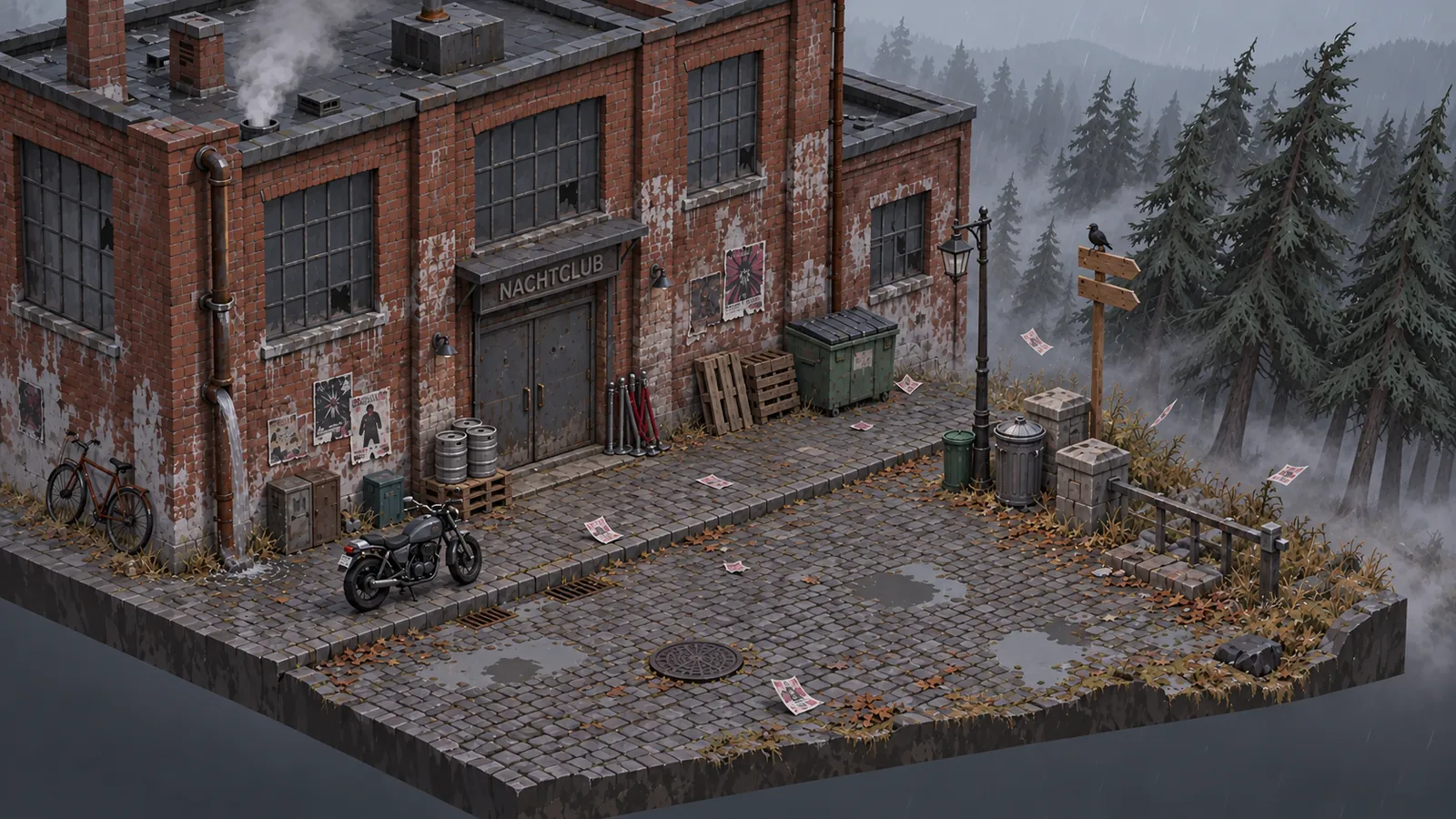
Art direction
Low-poly, deliberately staged.
Nachtclub is built from a few surfaces with different lives. One art bible shapes everything, so a rainy street, a salt mine and a field all feel like the same town.
Same building
Same building, different hour.
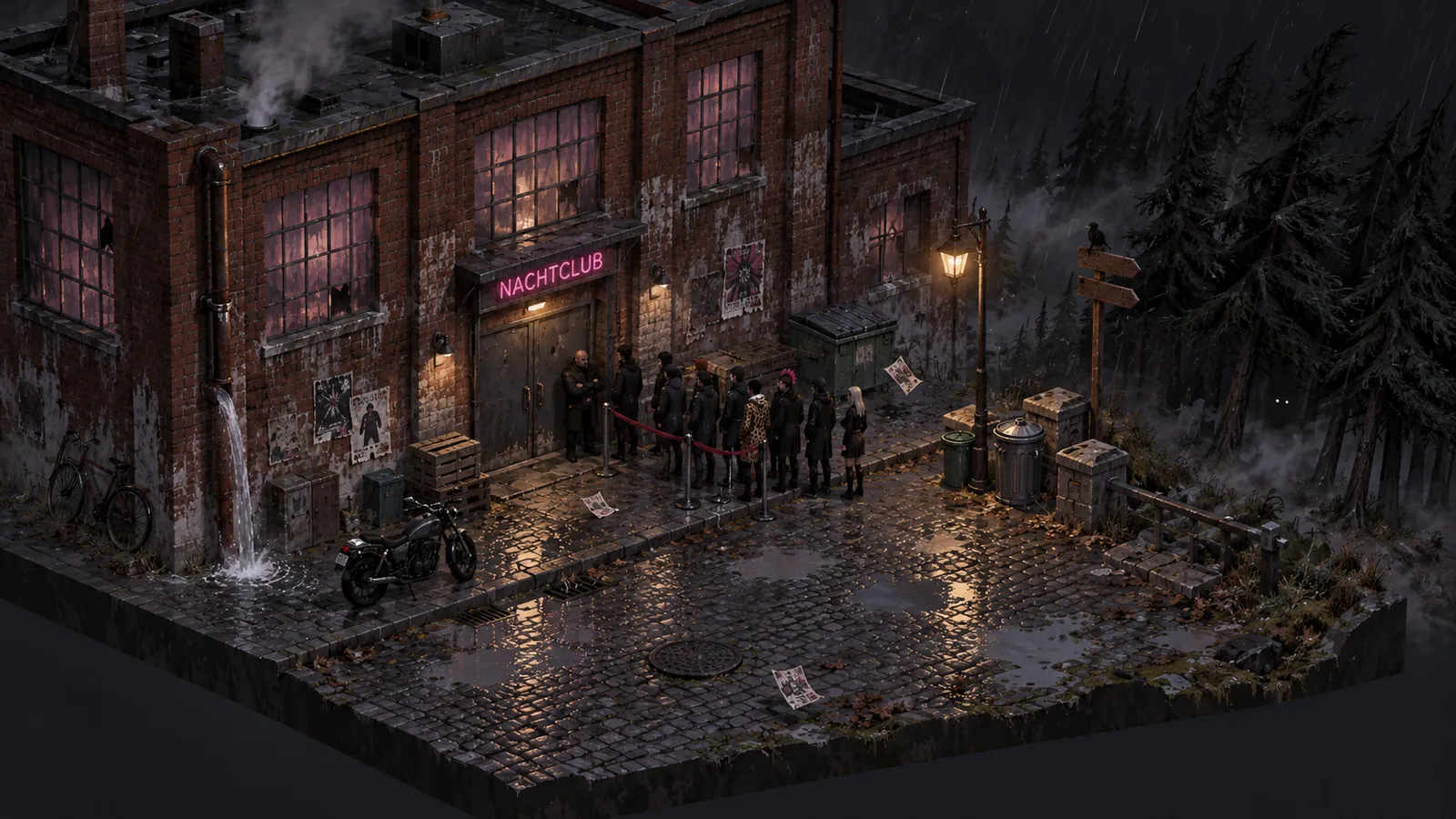 Before doorsAfter dark
Concept art. Drag the slider, or use the arrow keys.
Principles
Four rules we keep coming back to.
- 01
Flat colour, strong silhouettes
Simple masses and a restrained palette, readable from the game camera. Detail only where a place needs an identity: brick that has been repaired, metal that has worked, salt that has crept in.
- 02
Light that earns attention
Many practical lights, one that leads. Glow is off, a gentle tilt-shift stays on, and fog never hides the path. In the mine your lamps flicker three times, hold an ember, then go out.
- 03
A camera you can trust
Isometric and orthographic while you play: rotate in 90° steps, pull in or out. In scenes and some mini-games the camera goes free, with held frames and a single deliberate move.
- 04
Hear a room before you enter
Walk up to a door and the room inside starts to sound: bass, voices, vinyl hiss, or a silence on purpose. The camera settles closer while you decide.
Colour
A palette with a meaning for every colour.
Warm doesn't mean good and cold doesn't mean bad. Amber is a room someone lives in; magenta is the club's signal; salt blue and pale mineral belong to the mine.
Gallery
Concept art and engine captures.
Each place exists twice: as a painting that sets the mood and as a capture from the game that shows where we are. Every image is labelled.
How it's made
A straight answer about AI.
- In the game: every 3D model comes from our own Blender scripts. There is no AI image or model generator in the game.
- On this site: the concept art was made with AI to explore mood and composition, and is labelled “Concept”. It guides the art direction; it is not the game.
- Code: written with Claude and GPT Codex, and tested by us.
- The people: design, story, art direction, sound and every decision are the team's.
We take cues from Kentucky Route Zero's staging, sensory storytelling and attention to the ordinary, and keep our own rave culture, salt town and direct movement. Our shot language pairs Better Call Saul's patient wide frames with Mr. Robot's off-centre, quiet close moments.